


Prediction: This Is Where Pfizer Stock Will Be in 2030
Prediction: This Is Where Pfizer Stock Will Be in 2030

Reuben Gregg Brewer, The Motley FoolSat, August 22, 2026 at 2:35 PM UTC
0
Key Points -
Pfizer is one of the world's largest and oldest pharmaceutical companies.
It faces three notable patent expirations through the end of 2028.
10 stocks we like better than Pfizer ›
&&
Pfizer(NYSE: PFE) has an attractive 6.4% dividend yield. That compares to 1% for the S&P 500 index(SNPINDEX: ^GSPC) and 1.4% for the average pharmaceutical stock. Despite the outsize yield, the company is sticking by the dividend payment. That's great, but why is the yield so high? An examination of the business through 2030 will explain the problem.
What does Pfizer do?
From a big picture perspective, Pfizer sells pharmaceuticals. Only the drugs it sells don't appear out of thin air. It has to develop them or buy them before it can market them. That's an expensive, often time-consuming, and difficult process. This is why drug companies are afforded a limited, patent-protected window of exclusivity to sell their drugs. Drug companies like Pfizer can generate substantial revenue from patent-protected drugs.
Missed Nvidia in 2009? This Rare Signal Is Flashing Again.In 2009, a "Double Down" signal flashed for a little-known chipmaker called Nvidia. For the first time in years, that same "Total Conviction" signal is flashing for a company 1/100th the size of Nvidia. Continue »
&&
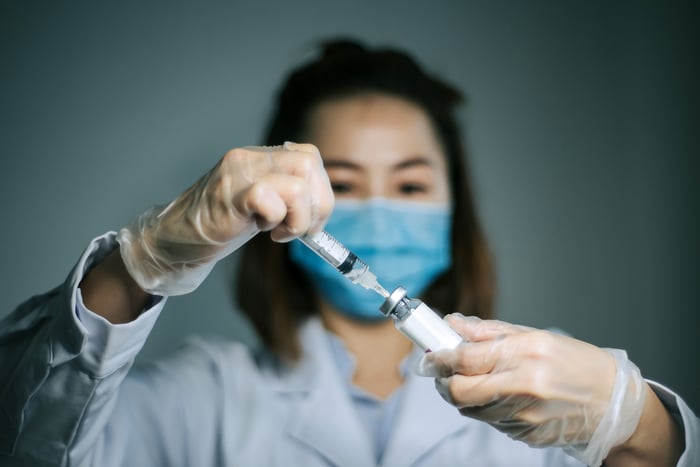
Image source: Getty Images.
There's just one small problem: revenues tend to fall dramatically after a drug loses patent protections. Complicating this is that developing new drugs doesn't follow a set timeline, unlike patent expirations. So sometimes there's a mismatch that puts pressure on a company's top and bottom lines.
That's what Pfizer is dealing with right now. In 2027, oncology drugs Ibrance and Xtandi are set to lose patent protection. In 2028, the cardiovascular drug Eliquis will lose patent protection. Pfizer is working hard to find drugs to replace revenue lost from these patent expirations, but investors are clearly worried that it won't be able to. It doesn't help any that the company suffered a material black eye when it had to drop its internally developed GLP-1 weight-loss drug candidate in 2025.
The GLP-1 pivot is a sign of Pfizer's strength
What's interesting about that GLP-1 misstep is that it also highlights the company's business strength, as Pfizer quickly bought a company with a more attractive GLP-1 candidate. It also has a number of other attractive drugs working through its pipeline, including in the oncology and migraine areas. Given the company's long history of success in the pharmaceutical sector, it seems highly likely that it will either develop new drugs internally or acquire them.
This means that by 2030, after the patent expirations in 2027 and 2028, Pfizer's revenues will likely be in recovery mode as new drugs hit the market. In fact, the company predicts that new drugs, either internally developed or acquired, will drive high-single-digit revenue growth after 2028, as the company continues to focus on its research and development efforts.
Advertisement
Pfizer: The process will never be over
Investors are worried about drug expirations right now, which makes sense. But Pfizer is likely to muddle through the upcoming patent expirations and start growing revenue again, which should lead investors to afford it a higher valuation. That's the good news. The bad news is that patent expirations are an ongoing issue for all drug makers, with Pfizer facing its next hit in 2031 when Vyndamax is set to lose its patent protection. However, if Pfizer gets through 2027 and 2028 in relative stride, it will likely get through 2031 as well.
Should you buy stock in Pfizer right now?
Before you buy stock in Pfizer, consider this:
The Motley Fool Stock Advisor analyst team just identified what they believe are the 10 best stocks for investors to buy now… and Pfizer wasn’t one of them. The 10 stocks that made the cut could produce monster returns in the coming years.
Consider when Netflix made this list on December 17, 2004... if you invested $1,000 at the time of our recommendation, you’d have $429,223!* Or when Nvidia made this list on April 15, 2005... if you invested $1,000 at the time of our recommendation, you’d have $1,318,055!*
Now, it’s worth noting Stock Advisor’s total average return is 965% — a market-crushing outperformance compared to 212% for the S&P 500. Don't miss the latest top 10 list, available with Stock Advisor, and join an investing community built by individual investors for individual investors.
See the 10 stocks »
*Stock Advisor returns as of August 22, 2026.
&&
Reuben Gregg Brewer has no position in any of the stocks mentioned. The Motley Fool has positions in and recommends Pfizer. The Motley Fool has a disclosure policy.
Source: “AOL Money”
