


Martin White, ‘textile consultant’ who ended his 75-year career as the last cloth merchant in Spitalfields
Martin White, ‘textile consultant’ who ended his 75-year career as the last cloth merchant in Spitalfields

Telegraph ObituariesTue, October 20, 2026 at 3:02 PM UTC
0
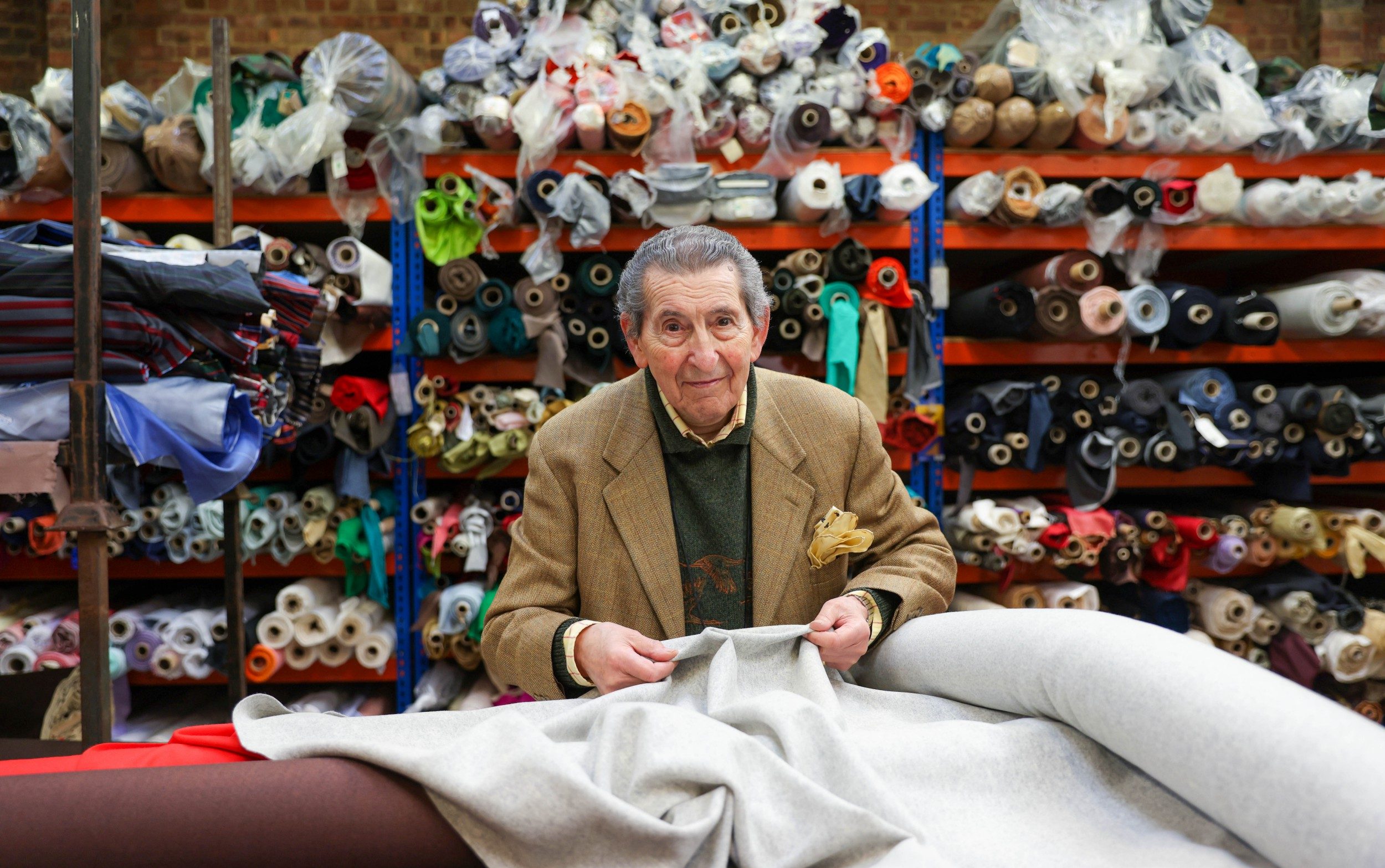
Martin White in his warehouse in 2021: his Instagram page declared, ‘No! We don’t sell online. Fabric has to be touched!’ - Bloomberg/Hollie Adams

Martin White, who has died aged 95, was the last cloth trader in Spitalfields, the East London district that had been at the heart of the British rag trade for more than 300 years.
White plied his trade for more than three quarters of a century, latterly as a totemic figure in Spitalfields instantly recognisable with his monocle and pearl tie pin, and invariably wearing a handmade shirt with immaculately turned cuffs. He and his business partner Philip Pittack developed a distinctive line in knockabout patter: “People have called us the Mike and Bernie Winters of the fabric industry,” Pittack observed.
Spitalfields was at the centre of the British textile trade from the late 17th century, when there was an influx of Huguenot silk weavers who came as refugees from France. Charles Dickens wrote a memorable article about a visit to a silk warehouse in Spital Square in 1851.
However, White’s decades in the business coincided with a decline in the industry owing to competition from abroad. By the time he founded his final business, Crescent Trading, in the early 1990s, there were 30 cloth warehouses left in Spitalfields; three decades later, White’s was the last.
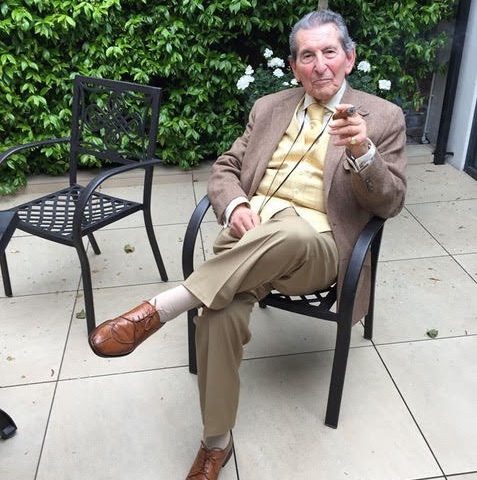
White: he began his career aged 14 in Soho – ‘a terrible place’ - Tracey White
With an authoritative eye for the hundreds of different types of wool, silk or cotton, White could size up the worth of a parcel of textiles on sight. He would tour the mills of Britain and Ireland and buy up the “overmakes” – the excess fabric that resulted from clients altering or discontinuing their orders.
Initially his business model was to buy up thousands of metres of cloth at a time and then supply the larger clothing manufacturers with high-quality material in bulk. But as the big manufacturers moved their operations to eastern Europe or China and the textile mills closed down in their hundreds, he pivoted to supplying small firms and shops.
Latterly Crescent Trading became the go-to supplier of discounted fabrics for designers – Vivienne Westwood was a regular – and the fashion students who proliferate in east London. When the young and penniless Alexander McQueen begged to be given a roll of cloth on tick, White agreed; he was not only duly repaid the £14, but remained a key supplier to the McQueen fashion empire in the ensuing decades.
Crescent Trading also supplied film and theatre costume designers, as well as fashion-conscious celebrities looking for material for bespoke clothing: regular customers included Helen Mirren, who made her own dresses from their cloth, and Mick Jagger.
Despite his ability to move with the times, White retained an old-fashioned sensibility, and Crescent Trading’s Instagram page bore the legend: “No! We don’t sell online. Fabric has to be touched!”
The business was thriving, when, in 2012, disaster struck: a fire caused by an electrical fault gutted their premises. “We’ve been to hell and back within these 12 months,” White said on Radio 4’s Midweek the following year. “To see a stock that’s taken us over 20 years to accumulate, all beautiful fabrics, all go up in smoke and dust and filth – to throw it all away – was heartbreaking.”
However, the 81-year-old White was undaunted. “Philip was a bit taken aback by it, he was speechless and in tears, [but] I said to him: ‘Come on, boy, pull yourself together, we started with nothing, we’ll start again.’”
Advertisement
They were badly under-insured, but, working out of a container in the warehouse yard while the building was refurbished, and with the aid of enormous goodwill from the locals, they had resumed trading within nine months. “There are half a dozen young designers looking through shelves of incredible fabric rolls,” one journalist reported in 2014. “The warehouse is busier than many of the coffee shops on nearby Brick Lane.”
Martin Harold White was born on May 25 1931, the son of William White, a leather merchant, cobbler and mechanic, and his wife Muriel. He was initially brought up in the East End, in Forest Gate, but the family later moved to a more salubrious home in Highgate.
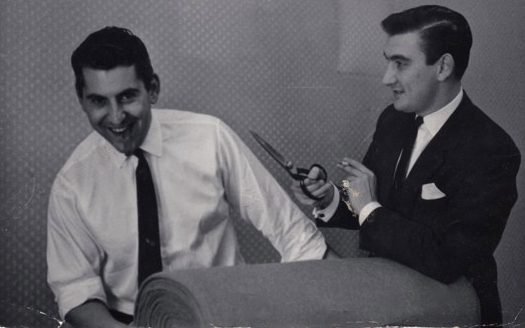
White, left, with his business partner Danny Secunda in 1956 - Tracey White
Martin had a sister, Diane, and a younger brother called Eddie who became a well-known bodybuilder: as Martin recalled, “eventually, he became Charles Atlas’s body. They would take the head of Charles Atlas and put it on a photo of my brother in the adverts for body-building.” Martin himself would lift weights until he was 92.
Aged 12, Martin took part in the Jewish rallies protesting against the release from prison of Sir Oswald Mosley in 1943. He left school in 1946 when he was 14, to work as a tea boy for his “two wicked uncles” who ran a textile shop in Soho.
“I hated it because all these men were coming in and using foul language that I’d never heard,” he remembered. “The centre of Soho was a terrible place.” However, the job proved an education: as Martin was tasked with being “the one who had to carry or schlep the fabric in from a lorry or van or taxi”, he acquired an intimate knowledge of the different cloth types.
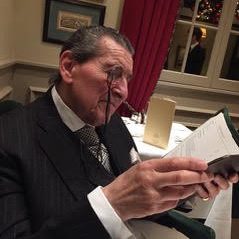
Martin White - Tracey White
Cloth was rationed in those postwar years, but Martin’s Uncle Joe was able to get a steady supply thanks to contacts in the mills of Manchester: business boomed, though Martin was only on £2 a week while his uncles made thousands. However, Uncle Joe eventually expanded Martin’s job specification to encompass spying on rivals or untrusted trading partners, and upped his wages to £5.
With this, Martin was able to buy a parcel of cloth in Brick Lane: 3,000 yards at a shilling a yard, which he sold on for three shillings and sixpence a yard. Launched as a trader and still only 15, he struck out on his own in partnership with a boy his own age, Danny Secunda. With no premises, they bought and sold fabrics from under a lamppost in Berwick Street, with a clientele hungry for material that was hard to obtain. “We made a good living between the two of us,” White told Spitalfields Life. “We were happy. We went out every night. And that lasted for about three years, before the business got hard when rationing ended.”
He went on to work for various textile merchants, including, in 1955, one whose daughter he had just married; but he fell out with his father-in-law, and the following year established his own premises for the first time, in Great Portland Street.

‘Textile consultant’: Martin White - Tracey White
Later on he moved to the East End and went into partnership with Pittack, who was a third-generation dealer in the rag trade: “He’s a rag merchant, whereas I am a textile consultant,” White insisted. Pittack died of Covid-19 in June 2020, aged 76, but White soldiered on alone as he entered his nineties.
Nobody was immune to White’s charm. When, driving in Shepherd’s Bush, he absent-mindedly knocked a man off a bicycle, the cyclist ended up apologising to him.
Martin White married, in 1955, Shela Mason; she died in 2018. They had two daughters, one of whom predeceased him, and he also adopted her son from a previous marriage.
Martin White, born May 25 1931, died August 27 2026
Source: “AOL Money”
